


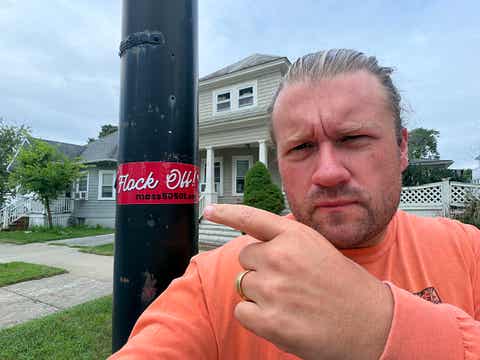
As the battle over automated license plate readers (ALPRs) reaches a critical juncture in New Bedford, local writer and commentator Nick LeBlanc has released a new toolkit aimed at keeping public pressure on the City Council.
Following a tumultuous legislative fight that saw the council pass an ordinance placing a temporary moratorium on mass location tracking, attention is now turning to an anticipated mayoral veto and the high-stakes override vote required to keep the rules in place. To help residents make their voices heard, LeBlanc has published two distinct form letters on his Substack publication, Residual Light—one tailored for the eight councilors who supported the ordinance, and another challenging the three who opposed it.
The Stakes Behind the Override
The controversy stems from the unannounced installation of Flock safety cameras in 2024, funded quietly through a line item labeled only as an “annual subscription.” Subsequent public scrutiny revealed that outside police departments had been querying New Bedford’s data without warrants, and local data was even utilized by officers to track romantic partners.
While the city has opted not to renew its contract with Flock, the underlying policy debate remains white-hot. Mayor Jon Mitchell has argued that a permanent ban compromises public safety, making a veto all but certain. When the ordinance returns to the council, proponents will need to secure eight votes—the exact number that initially passed it—to override the veto and enforce accountability.
Providing a “Frame to Hang Complicated Feelings On”
LeBlanc’s newly published letters break down the complexities of the debate for everyday citizens, addressing everything from the lack of public transparency to the department’s own written acknowledgments regarding the need for council oversight.
For the councilors who voted yes, the letter offers gratitude for standing firm through packed public galleries and long nights, while urging them to hold the line against the incoming veto. For the three councilors who voted no—Naomi R. A. Carney, Brian K. Gomes, and Shawn Oliver—the second letter challenges the narrative that the process was unfairly rushed, pointing to the two-year gap between the cameras’ quiet installation and public discovery.
“I know most of us have complicated feelings about all this, and sometimes it helps to have a frame to hang them on,” LeBlanc wrote, noting that the letters are designed to give neighbors a starting point to demand clear rules, data limits, and public audits before any new surveillance technology enters the city.
Residents looking to review the full text of the letters, along with direct contact information for each city councilor, can read the complete post on Nick LeBlanc’s Substack, Residual Light.