



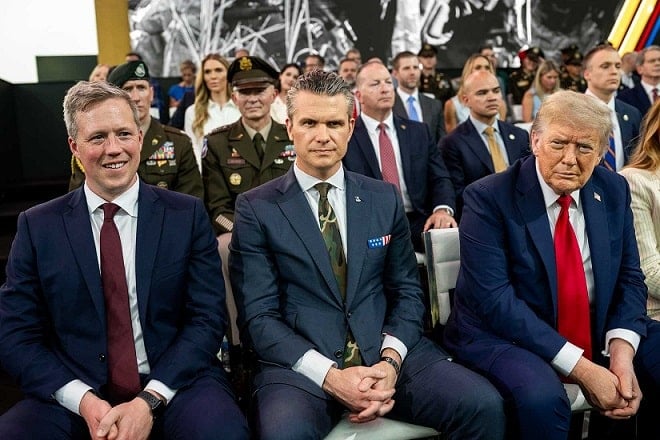
The Pentagon is reportedly hiring conservative military veterans with massive social media followings for unspecified government roles—a move that raises serious questions about whether the Defense Department is becoming less about serving the military and more about controlling the political narrative surrounding it.
According to The Washington Post, the Pentagon has hired two prominent conservative commentators: Rob Maness, a retired Air Force colonel with more than 135,000 followers on X, and Kurt Schlichter, a retired Army colonel with roughly 620,000 followers. Both are reportedly working under Anthony Tata, the undersecretary of defense for personnel and readiness.
The issue isn’t whether these men are conservative. The issue is why the Pentagon appears to be recruiting political influencers for government positions without clearly explaining what they are being hired to do.
That lack of transparency is particularly troubling under Defense Secretary Pete Hegseth, a former Fox News co-host who has repeatedly blurred the line between running the Pentagon and shaping the public’s perception of it.
Hegseth has pursued an aggressive communications strategy that includes bringing in a right-wing press corps to cover the Defense Department while restricting access for other news organizations—a policy that has already triggered lawsuits over press freedom.
At the same time, Hegseth has relentlessly promoted what he calls a “warrior ethos,” while repeatedly invoking battlefield “lethality” as a defining measure of military effectiveness. He also removed Army Chief of Staff Gen. Randy George in April without publicly explaining the decision, and President Trump has yet to nominate a permanent replacement.
Now, the Pentagon is reportedly putting high-profile conservative personalities on the inside while pushing independent military journalism further outside.
That is not a healthy direction for the nation’s military.
The Pentagon should not be building a political media operation with taxpayer dollars. Its responsibility is to maintain military readiness, support service members and provide the public with accurate information—not cultivate an ideological fan base.
The recent treatment of Stars and Stripes only intensifies those concerns. The Pentagon recently fired reporters at the long-running military publication, which operates independently despite receiving roughly 65% of its budget from the Defense Department.
Taken together, the pattern is difficult to ignore: less independent scrutiny, more message control, and increasingly visible reliance on partisan voices.
The American military belongs to the country—not to a political movement. The Pentagon owes the public a clear explanation of who it is hiring, why it is hiring them and what role their enormous social media platforms play in their government work. Yesterday Secretary Dan Driscoll has submitted his resignation after struggling with Hegseth for months over Hegseth’s firing of senior Army officers and over the direction of the military.
Driscoll’s departure, the journalists note, leaves the Army without any Senate-confirmed civilian or military leaders.
Until it provides those answers, skepticism is not only justified—it is necessary.