



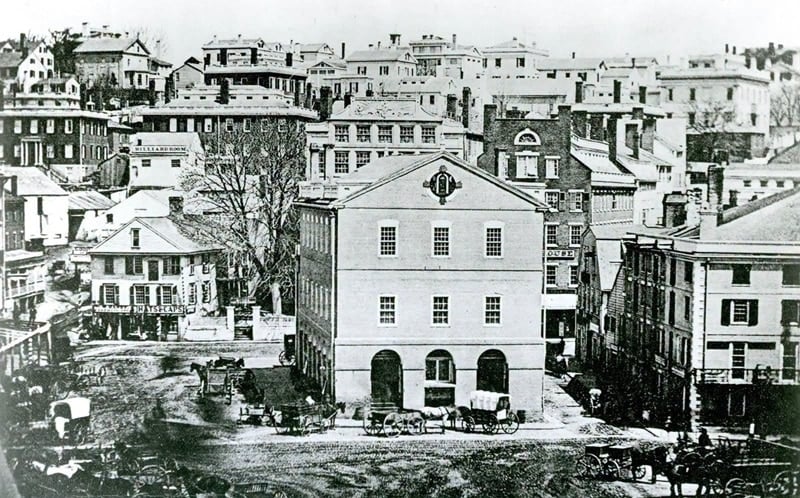
Few landmarks anchor a city’s history quite like the Market House in Providence, Rhode Island. Standing at the heart of what was once the bustling hub of colonial commerce, this historic building serves as a tangible bridge connecting modern-day Providence to its earliest roots as a colonial seaport.
A Crossroads of Commerce and Community
Dating back to the 18th century, Market Square was the vibrant focal point of the city’s civic and economic life. At its center stands the iconic Market House, constructed in 1775.
Designed to serve a dual purpose, the building operated as both a commercial hub and a municipal town hall. In its original layout, merchants set up their stalls on the ground floor to sell goods, while the upper floor functioned as a formal meeting hall for civic discourse and local government. Over the centuries, as Providence grew and transformed from a colonial trading post into a modern urban center, the square and its surrounding streetscapes witnessed the unfolding of American history.
From Colonial Port to Modern Campus
The evolution of Market Square offers a fascinating glimpse into urban preservation. A rare photograph of the square—captured around 1844—stands as one of the earliest known photographic records in New England. It depicts a busy, horse-drawn era when ships docked nearby and the waterfront directly touched the daily lives of citizens.
Fast forward to today, and the physical landscape has shifted significantly, yet the historic core remains remarkably preserved. The historic Market House, along with many of the surrounding architectural gems that define the area, has been integrated into the vibrant campus of the Rhode Island School of Design (RISD). Today, students, artists, and historians walk the very grounds where colonial merchants and town leaders once gathered.
Preserving the Past in the Present
While the tall masts of sailing ships have long since vanished from Market Square, the legacy of 1775 endures in brick and mortar. The Market House stands not only as a monument to New England’s architectural heritage but also as a reminder of how historic spaces can find new life, adapting to serve future generations while honoring the stories of the past.