


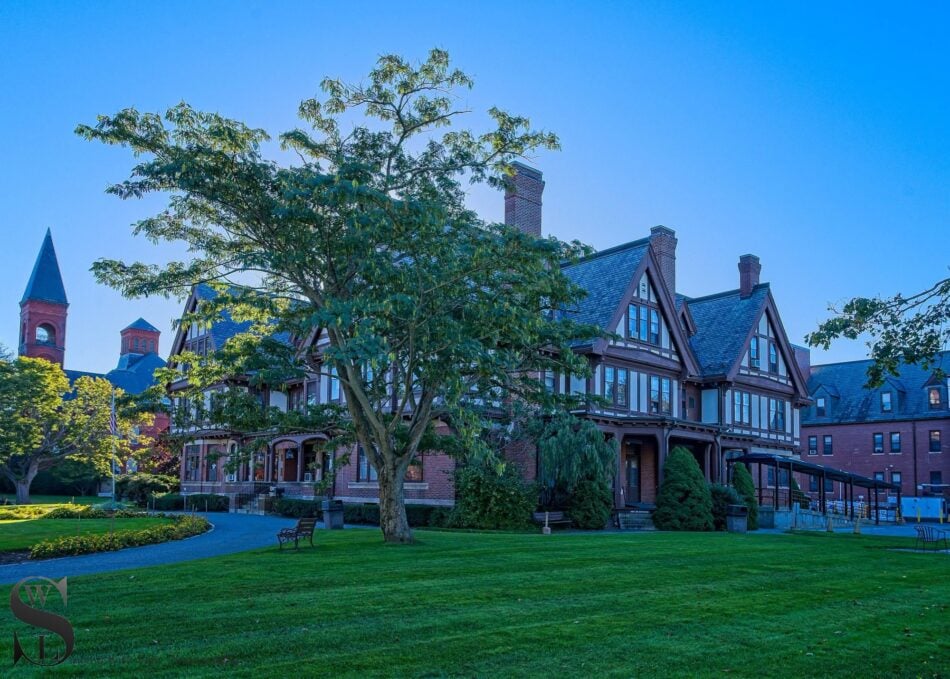
Long before it became a beacon of care and community, the grand structure standing in Fairhaven, Massachusetts, was envisioned as a luxurious countryside retreat. Its story is one of striking transformation—shifting from an elite Gilded Age hotel hosting America’s most famous literary figures to a wartime barracks, and finally into an enduring sanctuary of healing.
The Gilded Age Grandeur of the Tabitha Inn
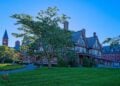
The history of the property began in 1905, when Standard Oil tycoon and prominent town benefactor Henry Huttleston Rogers decided to construct a premier destination in his hometown. Designed in a striking Elizabethan and Shakespearean architectural style, he named it the Tabitha Inn in honor of his great-grandmother.
Unlike many of Rogers’ civic gifts to the municipality, the Tabitha Inn operated as a commercial enterprise. It quickly gained renown as a magnificent grand hotel rivalling the finest establishments outside of Boston and New York, frequently welcoming elite travelers—including legendary author Mark Twain.
World War II and Military Requisition
As the global landscape shifted with the onset of World War II, the grand hotel’s role changed dramatically. Between 1942 and 1944, the U.S. Navy and Coast Guard requisitioned the building for military use. During these pivotal years, Coast Guard trainees attending the nearby New Bedford Vocational School were quartered within its historic halls.
A New Era of Compassion: Our Lady’s Haven
The end of its military chapter cleared the way for its most enduring purpose. In April 1944, Barney Zeitz sold the property to the Most Rev. James E. Cassidy, Bishop of the Fall River Diocese of the Catholic Church.
Following extensive interior remodeling, the building was formally dedicated on February 2, 1945, as Our Lady’s Haven. It opened its doors as a Catholic nursing home, lovingly staffed and operated by the Carmelite Sisters for the Aged and Infirm.
To meet the growing needs of the community, a modern 105-room brick addition was constructed at the rear of the historic structure in 1953. Decades later, in 1985, the Carmelite Sisters transitioned operations back to the Fall River Diocese.
Today, the landmark continues its legacy of service. Operating under Diocesan Health Facilities, it stands as a secular-and-faith-inclusive skilled nursing and rehabilitation center—seamlessly blending a century-old architectural heritage with modern compassionate care.