

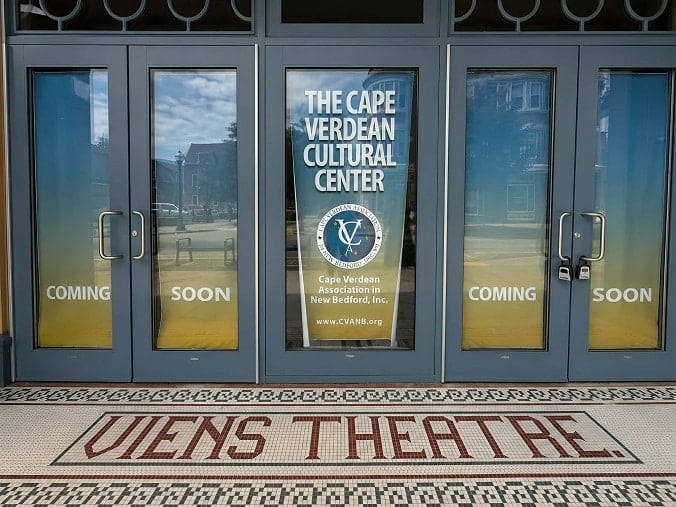

On a Saturday night more than a century ago, Acushnet Avenue looked very different than it does today. Today we turn back the clock with another historical article!
Electric lights glowed above ornate theater marquees. Horse-drawn carriages competed for space with the city’s new electric streetcars. Men in bowlers and straw hats escorted women dressed in their finest evening gowns past storefronts buzzing with activity. Music drifted onto the sidewalks, and crowds gathered outside theaters advertising vaudeville stars, comedians, singers, acrobats, dancers, and the latest moving pictures.
In the first decades of the 20th century, New Bedford’s North End wasn’t simply a neighborhood—it was an entertainment district.

The Idle Hour, Allen’s Theater, the Comique, and dozens of nearby saloons, restaurants, and shops kept Acushnet Avenue alive well into the evening. Yet among them all, one theater stood apart—not only for its performances, but for the remarkable woman whose name adorned its marquee.
That woman was Cordelia Vien.
Today, her name is unfamiliar to many New Bedford residents. But in her lifetime, Cordelia Vien built one of southeastern Massachusetts’ most successful theater businesses and helped shape the cultural heartbeat of the North End.
A Woman Ahead of Her Time
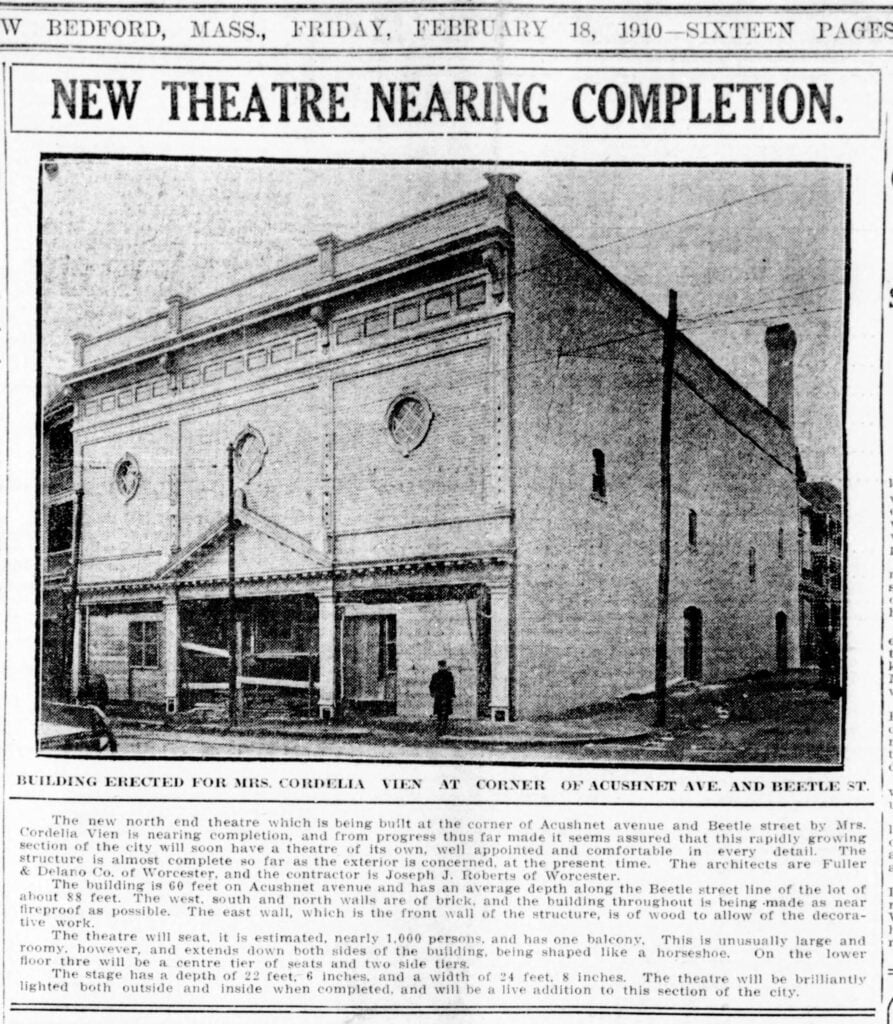
Construction began on the theater at 1157 Acushnet Avenue in 1896, during a period when New Bedford was one of the wealthiest cities in America, fueled by its thriving textile mills and maritime industries.
By 1909, the venue officially opened as the Cordelia Vien Theater, offering audiences the hottest form of entertainment of the era: vaudeville.
Every week brought an entirely new bill.
Comedy acts, opera singers, magicians, jugglers, acrobats, trained animal performances, traveling musicians, and exotic dancers filled the stage, ensuring that no two visits were ever the same.
Before Hollywood became America’s entertainment capital, vaudeville theaters were where families laughed together, where aspiring performers dreamed of making it big, and where touring acts crisscrossed the country by rail, bringing the nation’s most popular entertainers to cities like New Bedford.
Behind it all stood Cordelia Vien.
Although she and her husband, Francois Vien, jointly owned much of their real estate, contemporary newspapers consistently credited Cordelia—not Francois—as the driving force behind their expanding business empire.
At a time when women rarely received recognition as commercial developers or theater operators, Cordelia managed properties, negotiated leases, oversaw renovations, and expanded her influence well beyond New Bedford.
Trade journals took notice.
In 1914, Moving Picture World praised her success after she leased the Opera House in Lawrence:
“Cordelia Vien of the Vien’s Theater of New Bedford, Mass., took a three-year lease of the Opera House in Lawrence… The Vien’s Theater has always been a winner and Mrs. Vien is expected to duplicate her good work at the Opera House.”
Those words were remarkable for their time.
The magazine wasn’t complimenting her husband.
It wasn’t praising a business partnership.
It was recognizing Cordelia herself.
Following Francois’ death in 1912, she continued managing the family’s growing holdings alone for another sixteen years, becoming one of New Bedford’s most successful businesswomen during an era when female entrepreneurs remained the exception rather than the rule.
The Hotel With the Secret Passage
Cordelia wasn’t content to own just a theater.
She envisioned an entire entertainment complex.
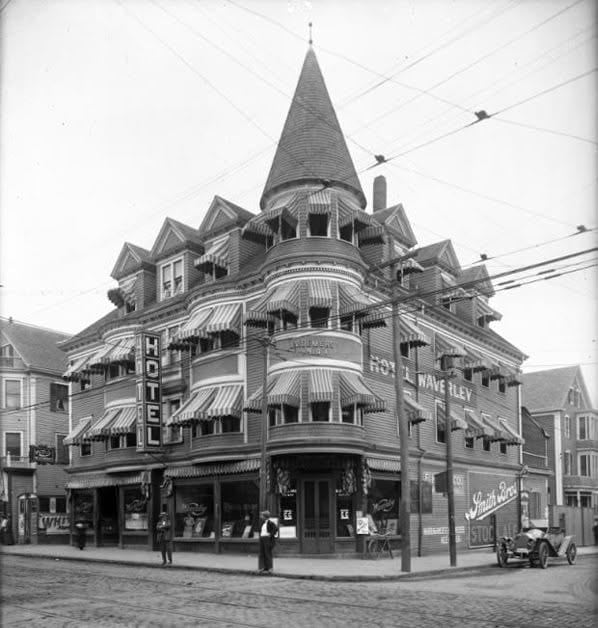
Directly across Acushnet Avenue stood another of her ambitious projects—the Hotel Waverly, located at 1162–1166 Acushnet Avenue.
Designed by noted New Bedford architect Samuel C. Hunt, the building opened in 1901 with a striking three-story turret rising above the corner of Acushnet Avenue and Beetle Street. Originally intended as apartments over retail stores, Cordelia recognized a greater opportunity.
By 1911, she had transformed the building into a full-service hotel catering to traveling entertainers.
Its lively corner barroom became a gathering place operated by Cordelia’s daughter, Marie-Anne Demers, her husband Joseph Demers, and Cordelia’s son, Eugene H. Vien.
But the hotel’s most fascinating feature remained almost entirely hidden.
Beneath Acushnet Avenue ran a tunnel.
Performers staying at the Hotel Waverly could leave their rooms, descend underground, and emerge backstage at the theater without ever stepping outside.
It was an ingenious convenience that reflected Cordelia’s eye for detail and hospitality.
Imagine arriving in New Bedford after days aboard a train, checking into the hotel, changing into costume, and walking beneath the street to the stage—all without facing rain, snow, or crowds.
It was the kind of thoughtful innovation that helped establish the Cordelia Vien Theater as one of the region’s premier entertainment venues.
From Vaudeville Palace to Movie House
By 1916, America was changing.
Motion pictures were becoming increasingly popular, and audiences were beginning to trade live variety shows for the magic of the silver screen.
Three local businessmen purchased the theater that year and renamed it The Strand Theatre.
Live performances didn’t disappear overnight, but silent films quickly became the theater’s primary attraction.
Then, in 1926, one of the country’s largest theater operators—E. M. Loew’s—acquired the Strand, ushering the building into the golden age of American movie palaces.
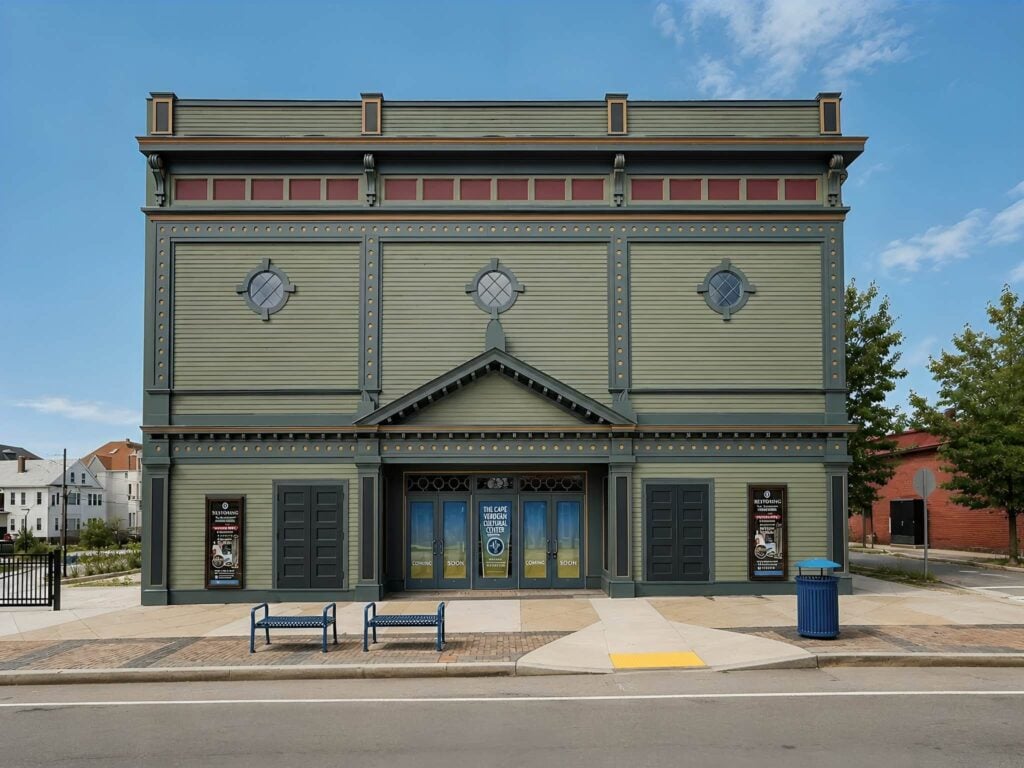
Originally, visitors approached an elegant Italianate façade filled with decorative architectural details that reflected the optimism and grandeur of the early twentieth century.
Like many historic theaters across America, however, the Strand fell victim to mid-century modernization.
During a major renovation in the 1950s, workers removed the ornate façade and covered the exterior with stucco, replacing Victorian elegance with the sleek, simplified appearance that was fashionable at the time.
Countless historic buildings met the same fate.
Today, preservationists often view those renovations with regret, but they also tell another chapter in the building’s long life—one that reflects changing tastes, changing audiences, and changing cities.
A Second Act Interrupted
The theater continued entertaining generations of New Bedford families throughout much of the twentieth century. Children watched Saturday matinees beneath its roof. Teenagers went on first dates there. Families escaped summer heat inside its cool auditorium.
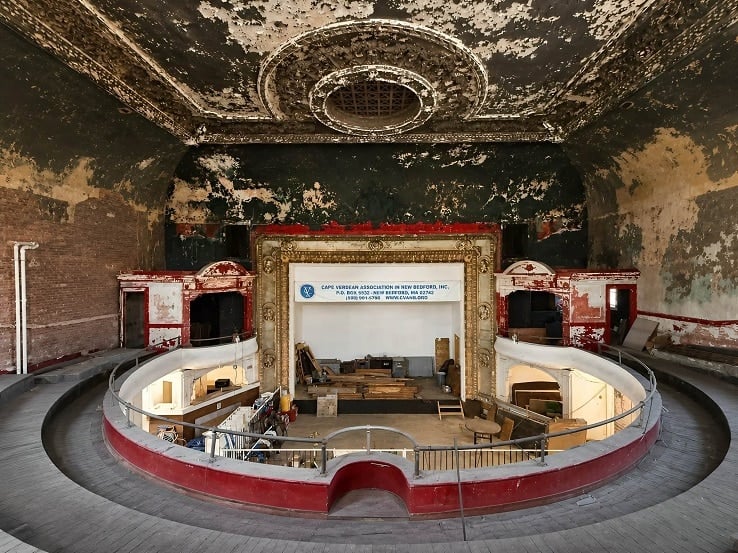
In 1983, the building entered another chapter under the name The Center, but tragedy struck when a devastating fire in 1990 forced its closure.
For decades afterward, the once-bustling theater stood largely silent. Yet even in neglect, its history remained impossible to erase. Its walls had witnessed vaudeville, silent films, talking pictures, neighborhood celebrations, and the changing face of Acushnet Avenue itself.
A New Beginning
Now, more than 125 years after construction first began, the Strand is preparing for perhaps its most meaningful transformation.
The historic theater is being restored as the future home of the Cape Verdean Association Cultural Center, ensuring that the building once again becomes a place where people gather to celebrate art, music, education, and community.
Plans call for a beautifully restored performance venue alongside classrooms, meeting rooms, rehearsal spaces, writers’ studios, technology instruction areas, galleries, and community gathering spaces. Concerts, theatrical productions, dance performances, films, poetry readings, art exhibitions, heritage craft demonstrations, workshops, and educational programs will once again fill the building with life.
The center will also serve as an important community resource through a partnership with the Office of the Consulate General of Cape Verde, providing assistance with immigration services, translation, passport and visa applications, legal referrals, powers of attorney, and citizenship documentation.
Just as Cordelia Vien once envisioned her theater as a gathering place for performers and audiences from near and far, the restored Strand will welcome new generations while celebrating the rich Cape Verdean heritage that has become such an essential part of New Bedford’s identity.
Remembering the Woman Behind the Marquee
For many years, the building has been known simply as The Strand.
Yet before it ever carried that name, it belonged to a woman whose vision transformed a stretch of Acushnet Avenue into one of New Bedford’s premier entertainment destinations.
Cordelia Vien was more than a theater owner.
She was a developer, a property manager an owner and an innovator; most remarkably, she accomplished it all during a period when few women were afforded such opportunities or recognition.
As restoration efforts breathe new life into the historic theater, they also offer something else: the chance to restore the memory of the woman who started it all.
Because long before the Strand became a movie house…
Before silent films…. Before the fire…
There was the Cordelia Vien Theater—and the extraordinary woman whose name first lit up the marquee on Acushnet Avenue.
Shout out to WHALE, NB Historic Club and Jason Baker Photography for some of the images in this article!