

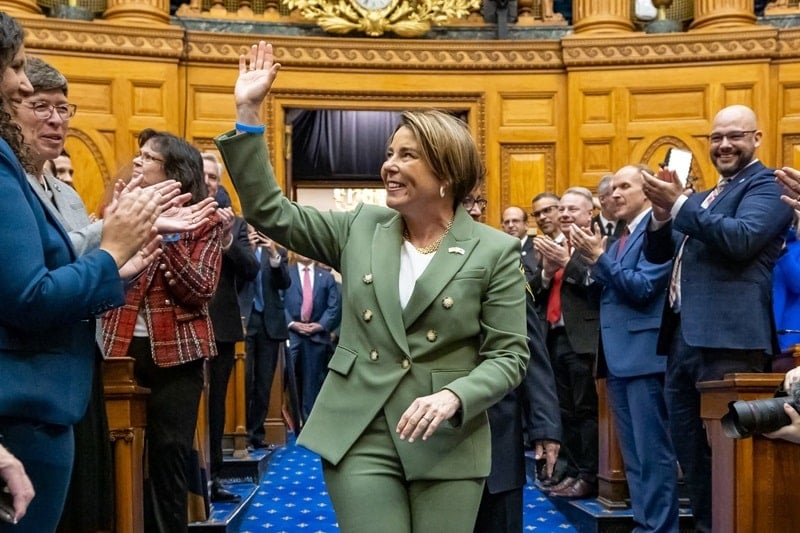

Gov. Maura Healey is moving to temporarily suspend Massachusetts’ gas tax for two months, a proposal she says would cut the price at the pump by about 24 cents per gallon statewide and provide roughly $120 million in relief to drivers.
Healey announced Tuesday that she is filing legislation to suspend the tax, saying she wants to take action to ease the financial pressure facing Massachusetts residents.
“I’m taking action as governor to do what I can to make life easier for people in Massachusetts to provide some relief,” Healey said.

The governor has attributed the state’s elevated gas prices in part to policies of President Donald Trump. Under Healey’s proposal, the revenue lost from the temporary tax suspension could be replaced with funds from the state’s millionaire’s tax.
The proposal, however, faces opposition from at least one key legislative leader. The plan must be approved by the Legislature before it can take effect.
House Speaker Ron Mariano previously expressed skepticism about suspending the gas tax, saying the Legislature has historically declined to do so because of concerns about transportation funding.
“Historically, the Legislature has chosen not to suspend the gas tax because it would limit our ability to fund critical infrastructure projects while doing little to alleviate costs for residents,” Mariano said. “With no end to the war in sight, a suspension of the gas tax would be fiscally irresponsible.”
The debate comes as Massachusetts drivers face sharply higher fuel prices. The average price of regular gasoline in the state is reported at $4.40 per gallon, up from $4.35 a week ago and $4.06 a month ago. At the same time last year, the average was $3.11 per gallon.
Diesel prices have climbed even higher, approaching record levels at approximately $6.39 per gallon, compared with $3.85 a gallon a year ago.
Healey’s proposal now goes to the Legislature, where lawmakers will determine whether the temporary gas-tax suspension becomes law. Minogue has plan that would suspend the state’s 24-cent gas tax whenever prices climb above $4 a gallon and work toward eliminating the levy. Are either one of the plans feasible long term?
.