


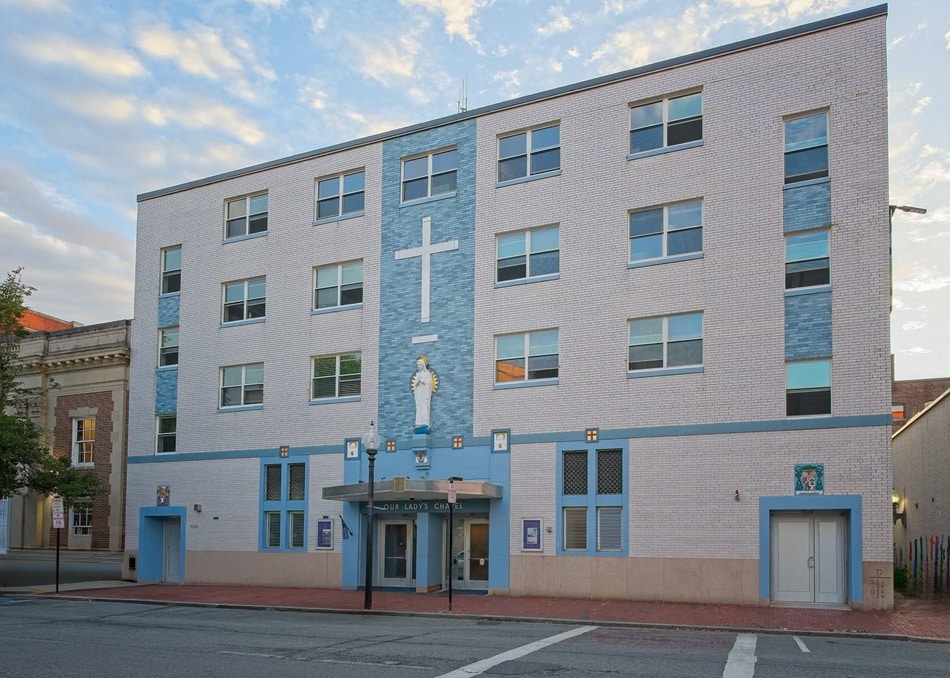
If you have ever walked through downtown New Bedford and admired the striking architecture and distinctive blue accents of Our Lady’s Chapel at 600 Pleasant Street, you are looking at more than just a landmark—you are looking at a living piece of the city’s twentieth-century history.
For generations of downtown shoppers, civic workers, and local residents, the chapel has served as a quiet spiritual sanctuary amidst the bustling rhythm of the city. But the building commuters see today is part of a dynamic evolution that stretches back over seventy years.
Roots in the Mid-Century Core
The chapel and its attached friary trace their origins back to 1950, when they were established by the Friars Minor (the Franciscans). Clad in their traditional habits, the friars quickly became a familiar and welcoming downtown presence.
Longtime locals remember the footprint of the site looking quite different in those early days. According to local historian and community member John Hoyle, who served as an altar boy at the chapel during the mid-1950s while attending high school, the original operation was much smaller.
“The original Chapel was in a small building on the south side of the chapel that you see now,” Hoyle recalls. “I was an altar boy while in high school during the mid-50s there along with many others from Holy Family.”
During this era, before Saturday evening vigil masses became common practice, Sunday mass requirements drew massive crowds. To accommodate the heavy demand, the schedule ran around the clock—including unusual pre-dawn hours.
“That was at the time that they allowed early morning Sunday masses because they still didn’t have Saturday masses, and we used to serve Mass at 1:30 and 2:15 in that Chapel,” Hoyle notes, adding with a nod to the era’s lively downtown nightlife, “They usually got tremendous crowds because of the Sunday mass requirements, [and] then many people would go to church after partying all Saturday night.”
Expansion and Continuity
As downtown New Bedford evolved, so did the chapel’s physical home. The original smaller structure eventually gave way to the larger, modern multi-level building that stands today. The new construction thoughtfully expanded the chapel’s capacity, featuring worship spaces both downstairs and on the main floor to handle the steady stream of faithful attendees.
Over the decades, the ministry within its walls shifted as well. In 1992, after the original Friars Minor relocated their community to Providence, another Franciscan order—the Franciscans of the Immaculate—stepped in to maintain the sacred space, continuing its legacy as the Marian Friary of Our Lady, Queen of the Seraphic Order.
A Lasting Downtown Legacy
Today, whether it’s local workers slipping away for a midday prayer or visitors admiring its unique exterior accents, Our Lady’s Chapel remains an enduring touchstone of New Bedford’s cultural and religious landscape. Thanks to the living memory of community members who served at its altar decades ago, the story of how a small mid-century chapel grew alongside the city continues to shine bright.