
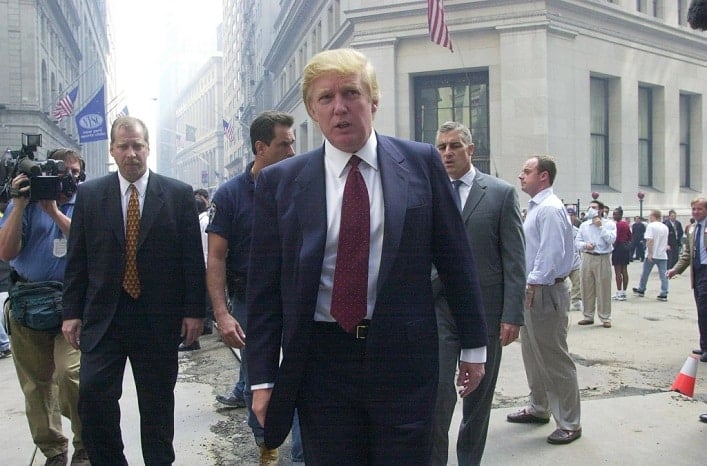

President Donald Trump is facing renewed scrutiny over a dramatic account of his actions after the September 11 attacks, after he claimed that firefighters physically carried him to safety as a nearby building threatened to collapse—an episode for which no publicly documented eyewitness or other corroborating evidence has emerged.
The claim, made at a Tunnel to Towers event, has reignited questions about Trump’s evolving descriptions of his role in the aftermath of the attacks and drawn criticism from 9/11 families and others who say the story risks turning a national tragedy into a personal tale of heroism.
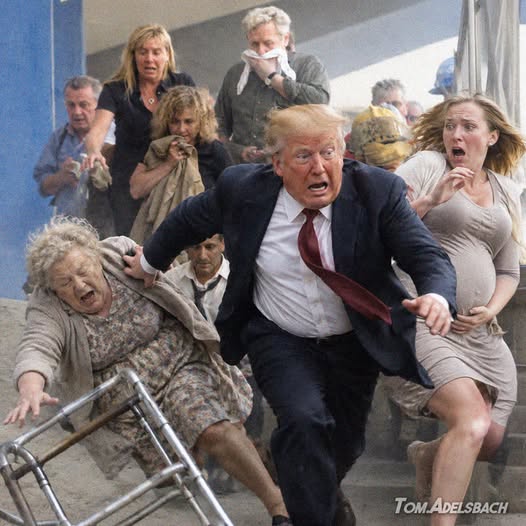
Trump said he was working on a building in New York following the attacks when, according to his account, a nearby structure began “creaking.” He said two firefighters grabbed him under the arms, “literally lifted me up,” and ran with him to safety because they feared the building was about to collapse.

The dramatic account has prompted renewed calls for scrutiny of Trump’s version of events. While Trump has repeatedly said he was in New York in the aftermath of the attacks, there is no publicly established evidence confirming the specific rescue he describes.
The controversy is particularly striking because there is a contemporaneous record of Trump’s comments on September 11 itself.
On the day of the attacks, in a television interview, Trump discussed the destruction of the World Trade Center and said that 40 Wall Street, his Manhattan property, was now the tallest building in downtown Manhattan because the Twin Towers had been destroyed.
That footage provides a record of how Trump was publicly describing the events at the time. It does not place him at Ground Zero or document the firefighter rescue he would later describe.
Years afterward, Trump’s accounts of his activities following the attacks became increasingly personal and dramatic. His description of being physically carried away by firefighters has now become a focal point of criticism over whether he has embellished his connection to one of the defining tragedies in modern American history.
The issue is not whether Trump was in New York after 9/11. The issue is whether the specific incident he describes—being lifted by firefighters and carried away from a supposedly collapsing building—actually occurred.
That distinction matters.
The September 11 attacks killed nearly 3,000 people, including firefighters, police officers and other first responders who rushed toward the danger rather than away from it. For survivors and families of the victims, accounts portraying oneself as having been rescued by first responders can carry particular emotional and historical significance.
Critics have described Trump’s account as a form of “false valor,” arguing that it portrays him as having played a heroic role in the immediate aftermath of the attacks without publicly available evidence establishing that he did.
Trump’s broader history of invoking military imagery has also become part of the criticism. He did not serve in the U.S. military, having received deferments during the Vietnam War era, but has frequently incorporated military imagery and rhetoric into his public persona.
The historical record of September 11 is unusually extensive: photographs, television footage, official investigations and thousands of firsthand accounts document the events of that day and their aftermath.
Against that record, extraordinary personal claims invite scrutiny.
Trump’s account of being carried to safety by firefighters remains a claim that has not been publicly corroborated. What is documented is that he spoke publicly on the day of the attacks about the destruction of the World Trade Center and its impact on his property.
The gap between that contemporaneous record and the much more dramatic account Trump has offered in subsequent years is now at the center of the controversy.
We found visual proof of him at ground zero…