



New zoning rules for downtown, Acushnet Avenue and Goulart Square put new emphasis on building design, walkability and neighborhood character.
NEW BEDFORD — A convenience store with a parking lot out front may be a familiar sight along Acushnet Avenue. Under New Bedford’s new zoning rules, it may soon become less so.
The City Council has approved new form-based zoning districts for three of the city’s major commercial areas — downtown, the Acushnet Avenue Marketplace and Goulart Square — changing not just what can be built, but how new buildings should relate to the streets and neighborhoods around them.
The rules are part of a broader effort by city officials to encourage development while making sure new construction fits the character of established New Bedford neighborhoods.
Traditional zoning tends to focus on land use: whether a particular property can have a restaurant, store, apartment building or other use.
Form-based zoning takes a different approach.
It puts more attention on the physical shape of development — where a building sits on a lot, how it meets the sidewalk, where parking is located and whether the ground floor contributes to an active pedestrian environment.
“Form-Based Code ensures that whatever is built carries the look and feel of the existing neighborhood, so these areas can grow while still maintaining what makes them unique,” Mayor Jon Mitchell said.
Mitchell credited Planning Director Jen Carloni and the Planning Department for developing the guidelines and thanked the City Council for approving them.
Moving parking out of the spotlight
The difference may be most apparent in the way new commercial properties are laid out.
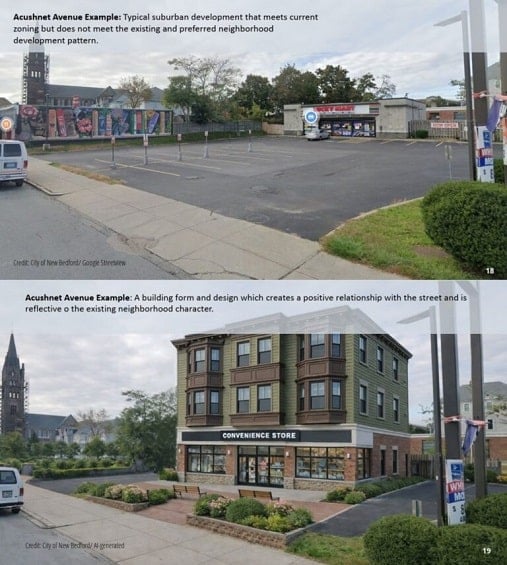
During a presentation to the City Council, the Planning Department used a typical convenience store on Acushnet Avenue as an example.
Under a more conventional suburban-style design, the store could sit toward the back of the property, with a parking lot between the building and the sidewalk.
The form-based regulations encourage the opposite arrangement: Put the building closer to the street, move parking to the side or rear and, where appropriate, incorporate housing above commercial space.
The goal is to create streets where buildings, rather than parking lots, define the pedestrian experience.
That does not mean the city is eliminating parking requirements.
The new regulations do not change how much parking is required. Instead, they encourage developers to locate parking in places that are less disruptive to pedestrians and the streetscape.
For a neighborhood such as Acushnet Avenue, where storefronts traditionally sit close to the sidewalk, the approach is intended to reinforce a pattern that already exists rather than replace it with a more automobile-oriented development model.
Three districts, one approach
The new form-based districts cover three areas with distinct identities.
The Downtown Business District includes New Bedford’s historic urban core, where buildings generally line the sidewalk and commercial activity is concentrated at street level.
The Acushnet Avenue Marketplace District is centered on one of the city’s longest and most diverse commercial corridors.
And the Goulart Square Neighborhood Center District is intended to strengthen a smaller-scale neighborhood commercial center.
While the three areas differ, the underlying philosophy is similar: New construction should contribute to the existing streetscape rather than stand apart from it.
That includes buildings that help frame streets, active ground-floor spaces and pedestrian-oriented design.
Another piece of New Bedford’s zoning overhaul
The form-based code is the latest in a series of zoning changes undertaken by the city in recent years.
The Mitchell administration has pushed a number of reforms aimed at encouraging new development and housing, including Transit-Oriented Districts near intercity rail stations, changes to parking requirements, accessory-dwelling-unit regulations, streamlined permitting, revisions to the city’s Table of Uses and changes to dimensional requirements intended to make housing development easier.
The reforms come as New Bedford looks to accommodate new investment and housing while preserving the character of its existing neighborhoods.
The City Council approved the new form-based regulations on Aug. 25, and Mitchell signed them into the City Code last week.
For developers, the changes provide a new set of standards for projects in the three districts. For residents, the more visible impact could come gradually, as older properties are redeveloped and new buildings begin filling in gaps along the city’s commercial streets.
The larger question is one many older cities are confronting: how to add housing and economic activity without turning established neighborhoods into something unrecognizable.
New Bedford’s new zoning rules attempt to answer that question by making the form of development itself part of the city’s planning strategy.