

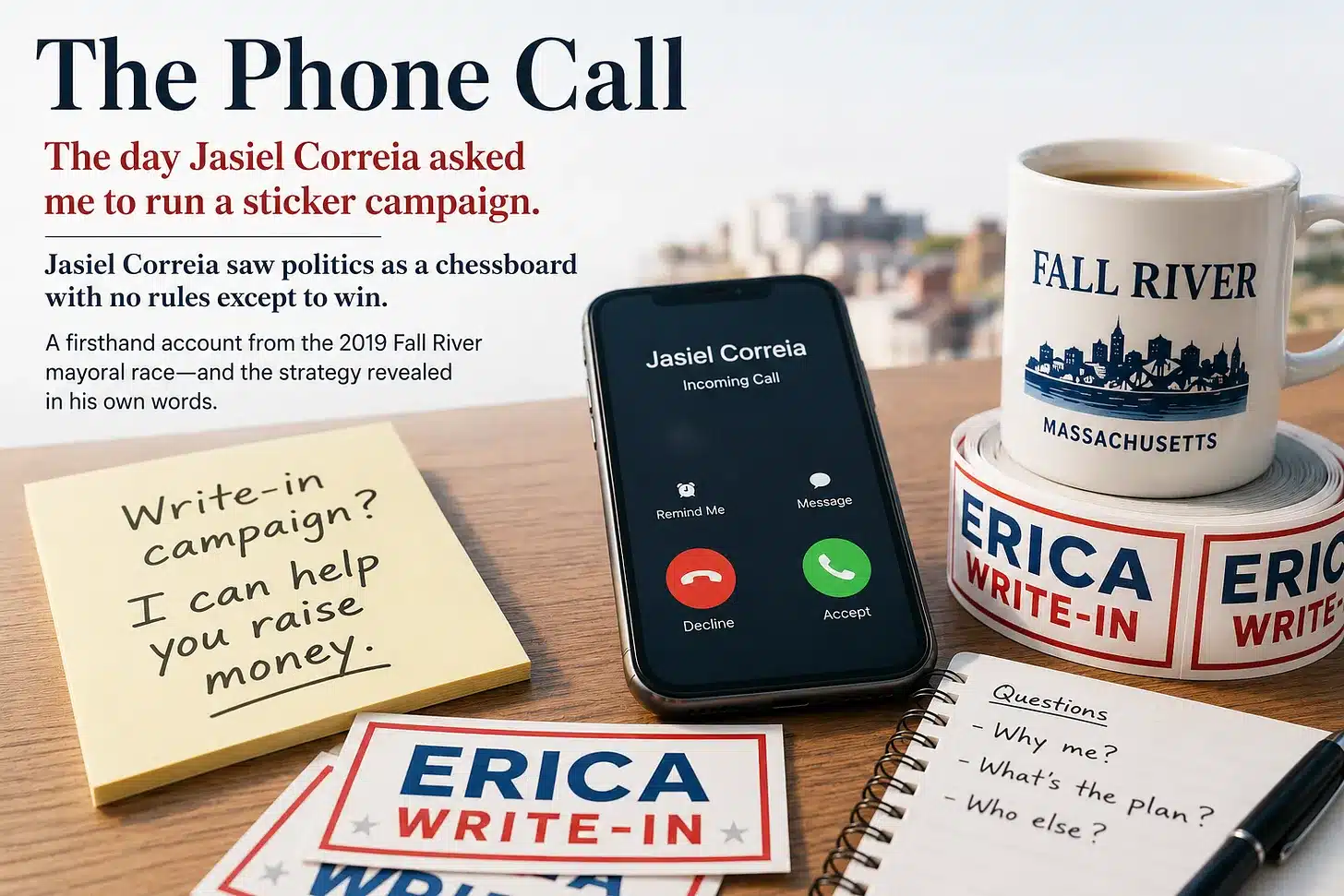

Former Fall River, Massachusetts Mayor Jasiel Correia is scheduled to be released from federal custody tomorrow, July 11, 2026. His release prompted me to write publicly, for the first time, about a conversation we had during the 2019 campaign season.
The Campaign Ends
The day after I lost the September 2019 mayoral preliminary, I flew to Washington, D.C. for work. I was disappointed, of course, but I also felt proud of what our campaign had built. I had never held elected office, yet our campaign earned more than 2,100 votes against my two male opponents who had spent years building political careers in Fall River. We didn’t inherit a political organization. We built one. Every volunteer, every supporter, every vote had been earned the old-fashioned way: by knocking on doors, making phone calls, and having conversations with neighbors.

The Rumor
While I was in Washington, I got a call from a friend with deep political connections in Fall River.
“I’ve heard Jasiel is going to step down as sitting mayor and drop out of the race,” they told me. “If he does before the filing deadline, you’ll move onto the November ballot. Would you run?”
Normally, I would have dismissed it as another campaign rumor. But this same friend had called me the night before Jasiel Correia’s second arrest, mere days before the Preliminary Election Day, and told me the FBI planned to arrest him the following morning. They were right. I never asked where the information came from. I just knew they had been right before.
So I watched the calendar. The filing deadline came and went, and nothing happened. I assumed the rumor was simply that, speculation.
Then Jasiel announced he was suspending his campaign. Because he waited until after the filing deadline, his name remained on the ballot.
That struck me as strange. If your goal was truly to step aside, why wait until your name couldn’t be removed? I didn’t have an answer, but I remember thinking there had to be more to the story.
The Phone Call
A few days later, I heard the answer direct from the source, from a phone call with Jasiel Correia.
He started by talking about the debates. He said I’d been too hard on him. He thought I’d done well. He also thought he’d done even better and “really shined”. Our mutual opponent Paul Coogan, in his opinion, had been terrible. Why, he asked, had I spent more time challenging him than Paul Coogan?
Then he asked whether I would consider running as a write-in candidate—a “sticker campaign,” as we call them in Massachusetts, where supporters are handed pre-printed labels to place over the write-in line on the ballot.
I’d just spent months campaigning, accepted the results of the preliminary, and gone back to work. Running a write-in campaign had never crossed my mind.
He told me he could help me raise money. I laughed and told him I couldn’t imagine he still had much of a political organization left after everything that had happened.
“You’d be surprised,” he said. I thanked him for the call and hung up in disbelief.
One Simple Question
The first person I called was my campaign consultant Elaine Almquist, a prominent political strategist. After listening to the conversation, she half-jokingly warned me that the FBI had likely been listening, and then she asked me one simple question.
“Do you want to run as a write-in?”
I told her I didn’t think so, that it was over, and the voters has spoken.
Democracy is about accepting the result, even when it hurts.
Elaine said she’d support whatever decision I made, but it had to be my decision—not Jasiel’s.
At the time, I still didn’t understand why he’d encouraged a sticker campaign. The whole conversation felt surreal, but I chalked it up to a politician struggling to accept that his campaign was collapsing.
The Strategy Revealed
Then the Fall River Herald News published leaked audio from one of Jasiel Correia’s campaign meetings. Listening to that recording, everything clicked.
Jasiel told supporters he had an unconventional strategy to win. Despite publicly announcing he was stepping aside, he wasn’t really conceding the election. Instead, he wanted to recreate the conditions that had allowed him to survive the March recall.
For readers outside Massachusetts, municipal elections are nonpartisan. A preliminary election narrows the field to two candidates, much like a primary. By the time Jasiel called me, that process had already happened. I had been eliminated, leaving what should have been a straightforward race between Jasiel Correia and Paul Coogan.
But just six months earlier, Fall River had held one of the most unusual elections in modern Massachusetts history. Voters recalled Jasiel from office, then reelected him on the very same ballot because four challengers split the replacement vote in a winner-take-all race, no preliminary. He believed he could recreate those conditions.
Jasiel Correia told supporters:
“It’s important because it makes it a multi-person race. I think everybody can read between the lines—a multi-person race like the recall.”
He then explained why:
“Right now there is only one outcome if we go ‘mano a mano,’ one on one: We don’t win… So I need your help to still win in an un-traditional way.”
Suddenly, the phone call made sense. He hadn’t called because he thought I should be mayor. He had called because another candidate in the race fit his strategy, and he thought the more write-ins, the better his chances of topping the pack, winner-take-all style.
The Sticker Campaign
Soon after, Cathy Ann Viveiros announced her own sticker campaign. Cathy Ann had served on the City Council, had previously run for mayor herself, and was then Jasiel’s City Administrator.
She later personally reached out to me and asked if I would support her campaign, saying that her sticker campaign vision best aligned with my campaign platform.
We met in person at a local Portuguese coffee shop. Cathy Ann insisted she was running entirely on her own, even when I questioned her about the timing.
I believed that she believed what she was saying.
But I also couldn’t ignore the sequence of events. Jasiel had asked me to run a sticker campaign. In his own words, he told supporters he needed “a multi-person race like the recall.” Then, another sticker campaign appeared—by his own City Administrator.
No Remorse
Years have passed since that campaign. Four of Jasiel’s co-defendants ultimately pleaded guilty and accepted responsibility for their roles, including his former Chief of Staff and campaign manager, Gen Andrade, and his landlord, David Hebert.
Jasiel never did.
When a jury convicted him of wire fraud, filing false tax returns, and extortion, Jasiel Correia walked out of the Boston courthouse and held an impromptu press conference, defiantly declaring:
“Unfortunately, the criminal justice system failed us today, but our fight is not over. Eventually the real truth will come out.”
At sentencing, U.S. District Judge Douglas Woodlock pointed to those comments as evidence of what he described as an “absolute lack of remorse.” The judge rejected the defense’s argument that Jasiel was simply having an emotional reaction to the verdict and concluded he had failed to accept responsibility for betraying the public trust.
To my knowledge, Jasiel has never publicly apologized to the people of Fall River.
Looking Back
During his more than four years in federal prison, he continued fighting his conviction, even filing handwritten, self-represented motions arguing that his prominent and well respected trial attorney, Kevin Reddington, had been ineffective. Reddington responded publicly that Jasiel still owed him a substantial legal bill.
Reading those filings, I found myself thinking back to that phone call. Even then—before the trial, before the convictions, before prison—Jasiel seemed convinced there was always one more move to make. One more strategy. One more explanation that placed responsibility somewhere else. One more opportunity to reshape the chessboard.
Elaine reminded me that afternoon that I still had a choice, even when someone was manipulating the rules of the game. I didn’t have to become part of someone else’s strategy.
I said no. Looking back, I’ve never regretted that answer.
Join the conversation and follow Erica on her Substack platform.

She writes about power, progress, and the stories people tell about both. Grounded in experience across fundraising, strategy, and her 2019 mayoral campaign in Fall River, Massachusetts.
Her space is for people who care about power, politics, systems, strategy, and the stories beneath the surface. Join the discussion in the comments, share your perspective, and support independent writing with a subscription.