


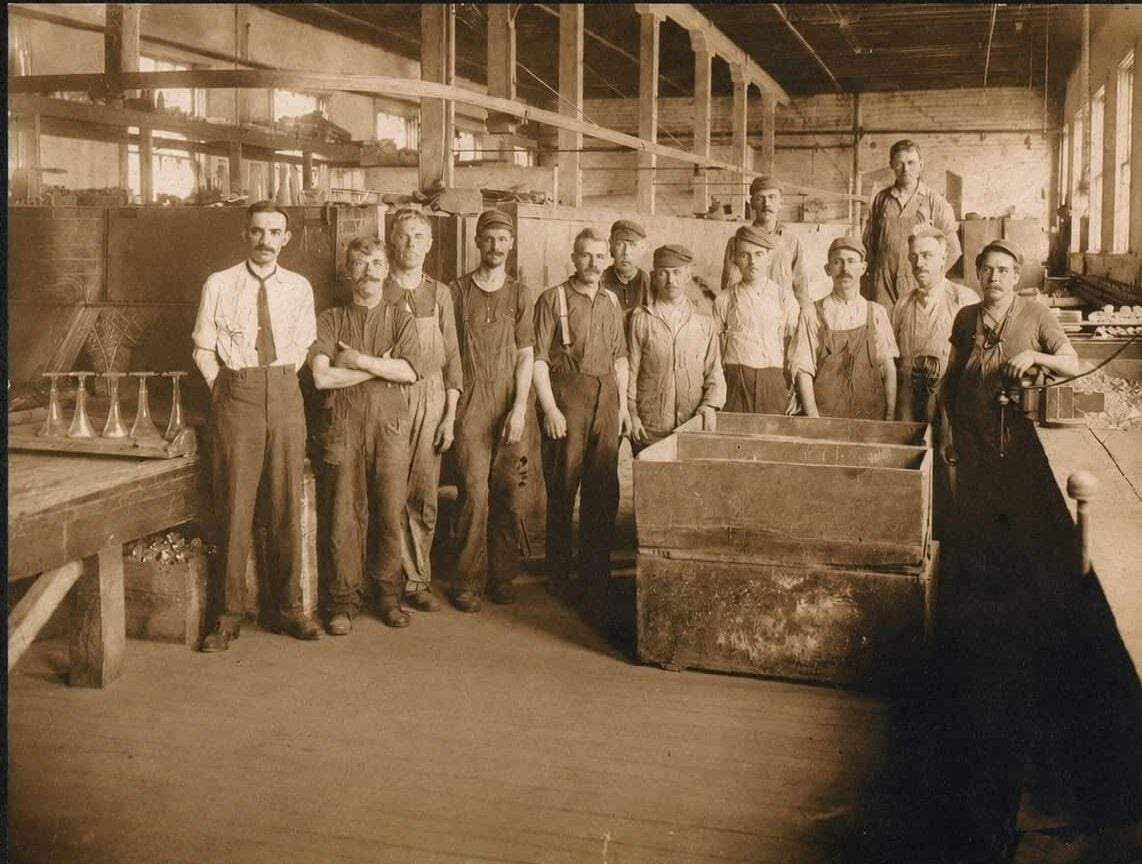
Today, travelers crossing the Sagamore Bridge onto Cape Cod can watch master artisans shape molten crystal at the Pairpoint Glass Company. Recognized as America’s oldest continuously operating glass manufacturer, Pairpoint’s roots stretch back nearly two centuries to 1837. While its furnaces now burn in Sagamore, the company’s golden age—and its very name—were forged during a transformative 87-year chapter in New Bedford, Massachusetts.
Origins and the Move to New Bedford

The company began in South Boston in 1837, founded by glassmaking pioneer Deming Jarves as the Mount Washington Glass Works. By 1870, needing room to expand and modernize, the company relocated to New Bedford. The move proved pivotal. New Bedford, already transitioning from its whaling heyday into a powerhouse of textiles and precision manufacturing, offered skilled labor and coastal shipping access.
Under the leadership of superintendent Frederick S. Shirley in the 1870s and 1880s, the New Bedford glassworks entered an era of extraordinary artistic innovation. Local artisans developed and patented world-renowned styles of Victorian art glass:
- Burmese Glass (1885): A heat-sensitive, translucent glass that shaded seamlessly from soft yellow to coral pink. It proved so popular that the company secured a British patent and presented custom pieces to Queen Victoria.
- Signature Victorian Lines: Mount Washington’s New Bedford furnaces also produced Peachblow, Crown Milano, Lava glass, and Royal Flemish—ornate, gilded, and hand-painted wares that defined Gilded Age luxury.
A Marriage of Glass and Silver
Pairpoint’s defining New Bedford connection arrived in 1880. That year, renowned British silver designer Thomas J. Pairpoint established the Pairpoint Manufacturing Company on land directly adjacent to the Mount Washington factory on Prospect and Howland Streets. Recruiting fifty skilled metalworkers from Connecticut, Thomas Pairpoint began crafting intricate, silver-plated mounts, frames, and bases designed specifically to hold Mount Washington’s art glass.
The partnership between the neighboring factories was a massive commercial and artistic triumph. In 1894, the two companies officially merged, reorganizing in 1900 as The Pairpoint Corporation.
At its peak in New Bedford, Pairpoint employed thousands of local workers, glassblowers, engravers, and silversmiths. With the rise of residential electricity at the turn of the 20th century, the company pivoted to lighting. Between 1907 and 1929, Pairpoint’s New Bedford decorators became famous for reverse-painted glass lampshades and mold-blown “puffy” floral lamps, pairing hand-painted glass domes with sculpted metal bases.
Transition and Modern Legacy
Like many American manufacturers, Pairpoint faced severe headwinds during the Great Depression and from post-World War II foreign imports. The original corporation closed in 1938, though glassmaking in the New Bedford plant was kept alive by master glassblower Robert Gundersen—operating first as the Gundersen Glass Works and later as the Gundersen-Pairpoint Glass Works—until the historic New Bedford factory finally closed its doors in 1957.
Refusing to let the legacy die, plant manager Robert Bryden relocated operations briefly to East Wareham and then overseas to Spain before returning to Massachusetts to build the company’s current factory in Sagamore in 1970. Acquired by brothers Jeffrey and Gary Tulman in 2015, Pairpoint continues to craft hand-blown crystal, signature bubble-ball stemware, lighting, and commemorative cup plates.
Experiencing the Legacy Today
Pairpoint’s New Bedford craftsmanship is preserved in more than 30 major institutions nationwide, including the Metropolitan Museum of Art and the Smithsonian. Closer to home, visitors can explore the city’s glassmaking heritage right at the New Bedford Museum of Glass on County Street, which houses an extensive collection of local Mount Washington and Pairpoint treasures, or take a 30-mile drive east to Sagamore to watch Pairpoint’s glassblowers keep New Bedford’s fiery tradition alive.