


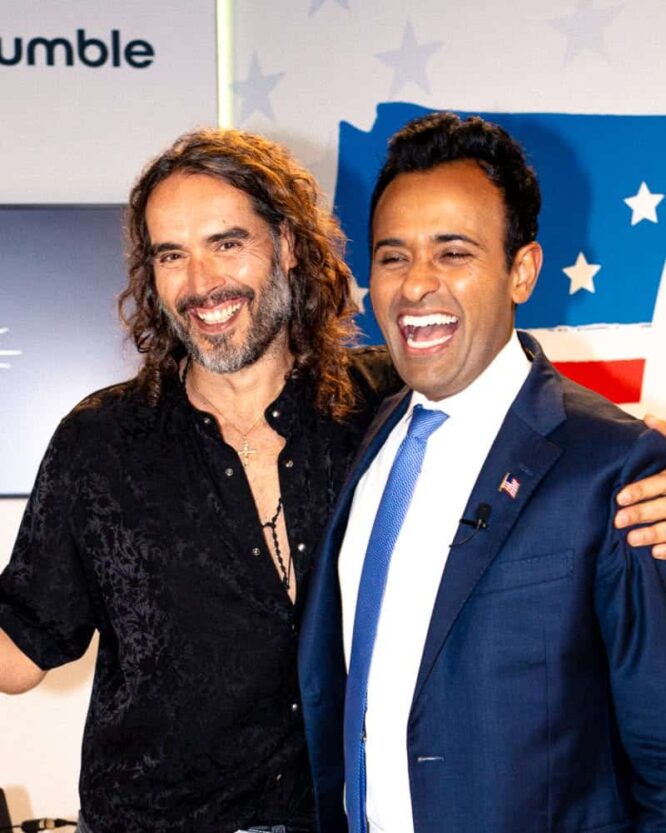
LONDON — Once celebrated as a boundary-pushing comedic lightning rod and a Hollywood fixture, Russell Brand’s dramatic trajectory reached a stark legal and cultural reckoning. A jury at London’s Southwark Crown Court convicted the 51-year-old entertainer of one count of rape and three counts of sexual assault, bringing an end to a high-stakes trial that laid bare a decade of predatory behavior masked by celebrity culture.
Presiding Judge Mr Justice Bennathan remanded Brand into custody following the verdict, warning that the convictions carry an inevitable “significant custodial term” ahead of sentencing. As officers led him away, Brand made “OK” gestures and told the court, “I’m good, I’m good, I’m good”.

The verdict marks the ultimate collapse of a public figure who spent the latter half of his career weaponizing anti-establishment rhetoric, cycling through radical conspiracy theories, and cultivating a devoted digital following.
The Trial and the Allegations
The trial centered on allegations brought forward by six women spanning a ten-year period between 1999 and 2009—the height of Brand’s rise from eccentric British stand-up comic to mainstream television and radio host, and later, a Hollywood actor in films like Forgetting Sarah Marshall.
Prosecutors characterized Brand as a calculated sexual predator who exploited his immense fame, status, and corporate backing to target and intimidate vulnerable women. The jury heard harrowing details of assaults occurring across various locations, including media offices, radio stations, and Brand’s own home.
While Brand admitted on the stand to being intensely promiscuous during his early years and leveraging his celebrity for sexual access, he maintained that all encounters were consensual. His defense team argued that public scrutiny and investigative media pieces had distorted the complainants’ recollections. Ultimately, the jury rejected those arguments, finding him guilty of one count of rape and three counts of sexual assault, while acquitting him of two other rape charges and an attempted indecent assault charge.
Detective Superintendent Andy Furphy of London’s Metropolitan Police lauded the complainants for their tenacity. “Brand used his influence, status and fame to exploit and sexually offend against women,” Furphy said. “As his profile grew, so too did his sense of entitlement. I hope this conviction sends a clear message that no one is above the law, no matter how famous or powerful they may be.”
The Descent Into Right-Wing Zealotry and Alternative Media
Long before the gavel fell in Southwark Crown Court, Brand had already engineered a radical reinvention of his public persona. As his mainstream entertainment career cooled and allegations began swirling behind the scenes, Brand pivoted aggressively away from traditional Hollywood and British broadcasting.
He retreated into the digital ecosystem, building a massive streaming empire on platforms like Rumble and YouTube. Under the guise of a truth-seeking populist and anti-establishment iconoclast, Brand transformed himself into a darling of the contemporary right-wing media sphere.
His daily broadcasts became a revolving door for fringe narratives, culture-war grievances, and pseudoscientific posturing. Where he once spoke using eccentric, left-leaning comedic language about wealth inequality and spiritual awakening, his commentary curdled into heavy alignment with far-right talking points, medical skepticism, and institutional distrust. He seamlessly blended political paranoia with spiritual wellness marketing, creating an insulated echo chamber of millions of followers who viewed any external criticism or investigative pressure as part of a global elite conspiracy targeting him.
Pseudoscience, Autism, and the Pipeline to Extremism
As Brand’s political alignment shifted deeper into right-wing zealotry, his platform increasingly amplified bizarre medical claims, alternative health conspiracies, and provocative assertions about neurodivergence.
In various online segments, Brand leaned heavily into controversial tropes regarding modern medicine, vaccines, and public health institutions—frequently positioning himself as a persecuted dissident fighting “matrix-like” control structures. This conspiratorial worldview naturally bled into how he discussed developmental conditions and mental health.
Critics and digital media watchdogs repeatedly flagged Brand for broadcasting wild claims concerning autism, linking neurological conditions to environmental toxins, globalist plots, or lifestyle failures while platforming discredited wellness gurus. By weaponizing skepticism around legitimate medical science, Brand preyed on audiences looking for simple answers to complex health realities, wrapping dangerous misinformation in charismatic, pseudo-philosophical monologues.
This relentless descent into digital radicalization served a dual purpose: it monetized grievance culture while laying the groundwork for a dedicated defense network. By the time legal walls began closing in, Brand had already conditioned his base to believe that any mainstream institution—be it journalism, the judicial system, or law enforcement—was inherently corrupt and out to silence independent thinkers.
A Reckoning for Accountability
The verdict shatters the protective bubble Brand spent years constructing online. What began as a series of disturbing accounts from brave women detailing abuse behind studio doors has culminated in a definitive criminal conviction.
For years, Brand hid behind the armor of digital counter-culture, rebranding himself as an anti-censorship martyr while evading the consequences of his past. Now, facing a mandatory prison sentence, the illusion has fractured—leaving behind the stark reality that no amount of online posturing or algorithmic grievance can outrun accountability.