


In 1831, workers digging near Fifth and Hartwell Streets in Fall River, Massachusetts, made an astonishing discovery: a human skeleton sitting upright, wrapped in dark bark and coarse fabric. Most striking were the artifacts found with it, including a brass breastplate, a belt made of brass tubes, and nearby metal arrowheads.
Discovery and Fate
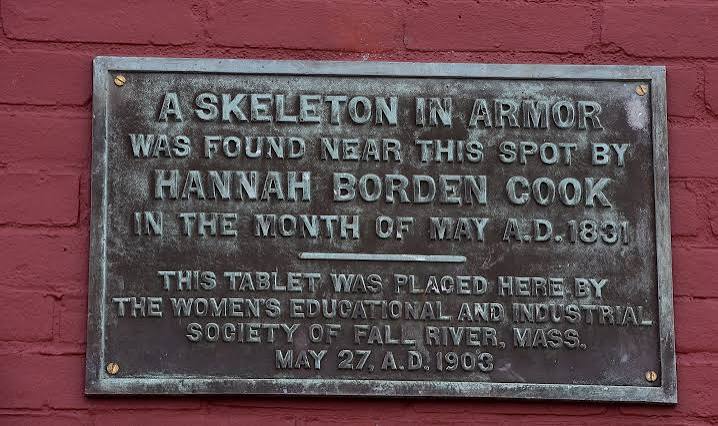
- The Find: Unearthed in May 1831 by Hannah Borden Cook during excavations in a sandbank.
- The Relics: The body was buried in a seated position, adorned with a distinct brass chest plate and tubular brass belt.
- Destruction: Transported to the Fall River Athenaeum, the remains were tragically destroyed in the Great Fire of July 2, 1843. Today, only a few brass tube fragments survive at the Fall River Historical Society.
Theories of Origin
- Native American Burial: Modern historians and archaeologists widely agree the remains belonged to a local Wampanoag or Narragansett leader buried alongside 17th-century European trade goods.
- Norse Explorer: In the 19th century, romantic speculation popularized the belief that the skeleton was a 10th-century Viking warrior.
- Alternative Claims: Over the years, fringe theories also suggested the remains could be an early Phoenician, Carthaginian, or Portuguese explorer.
Cultural Legacy
- Longfellow’s Ballad: The discovery captured the national imagination and inspired Henry Wadsworth Longfellow’s famous 1841 poem, “The Skeleton in Armor.”
- Commemorative Marker: A bronze tablet commemorating the find was erected nearby in 1903. After being stolen and recovered in 2018, the plaque was reinstalled on a secure, camera-monitored wall at the Liberty Utilities building on Fifth Street.

ADVERTISEMENT