


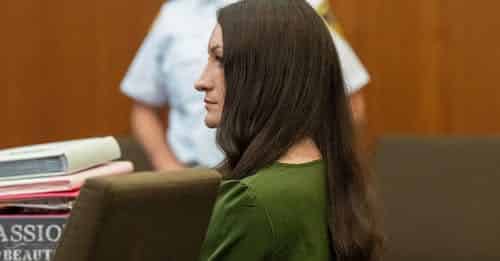

Jurors in the Lindsay Clancy trial were sent home early Wednesday after hearing testimony from a defense mental health expert, while Judge William Sullivan ruled that a TikTok user who previously worked at McLean Hospital would not be allowed to testify.
The jury had already endured an extended wait while Sullivan considered whether the proposed defense witness could testify. The judge ultimately rejected the witness, who had reportedly worked at McLean Hospital and later discussed the case on TikTok.
After the lunch break, Sullivan sent the jury home, citing an “unforeseen circumstance.” He did not elaborate but instructed jurors not to speculate and said the trial would resume Thursday.

The case centers on the January 2023 deaths of Clancy’s three children at the family’s Duxbury home. Clancy has pleaded not guilty. Her defense acknowledges that she killed the children but argues she was not criminally responsible because she was suffering from postpartum psychosis.
Defense expert describes voices Clancy said she heard
Earlier Wednesday, Dr. Paul Zeizel, a clinical and forensic psychologist, completed his testimony about dozens of meetings with Clancy after the killings.
Zeizel testified that Clancy described hearing a male voice ordering her to kill her children and then herself. He said she remembered the killings, but that her memory of the events was “fuzzy.”
When defense attorney Kevin Reddington asked whether he had planted that account in Clancy’s mind, Zeizel responded, “Absolutely not.”
Reddington asked Zeizel about Clancy’s medical records from Jan. 7, 2023, about two weeks before the children were killed.
“Did she have, at this point, intrusive thoughts continuing, regarding voices in her head that she heard constantly?” Reddington asked.
“Yes,” Zeizel replied.
“What were these voices saying to her?”
“They were getting worse, and they were telling her to kill herself,” Zeizel said.
Prosecutor Shanan Buckingham challenged that testimony, asking whether Clancy had told any of her medical providers between September 2022 and January 2023 that she was hearing a voice telling her to kill herself.
“It’s not in the records,” Zeizel acknowledged.
Buckingham also asked how many times Clancy had told Zeizel since the killings that she was currently hearing voices.
“She has not heard voices since the event took place in 2023,” Zeizel said.
The prosecution reviewed records from Tewksbury State Hospital, including entries from the anniversaries of the killings and the children’s birthdays. Prosecutors pointed out that the records did not document behavioral health issues on those dates.
Former colleague recalls Clancy’s concern for her children
Margaret Hamp, a labor and delivery nurse at Massachusetts General Hospital, also testified about her experience working with Clancy.
Hamp said she worked with Clancy for about seven years and recalled that Clancy frequently checked on her children while she was working shifts.
Hamp described one incident in which one of Clancy’s children was seen crying on a baby monitor. When Clancy’s husband did not answer the phone, Hamp said Clancy called for a wellness check.
The testimony offered the jury another account of Clancy’s behavior as a mother before the January 2023 killings.
Prosecution’s final witness testified about phone data
The prosecution’s final witness was Ian Whiffin, an employee of Cellebrite, who testified about data extracted from Clancy’s cellphone.
Whiffin described his examination of Apple Health data and other information recovered from the phone, including heart-rate information and search history.
Among the searches he discussed was a search for symptoms of postpartum psychosis.
Whiffin previously testified in the murder trial of Karen Read, another high-profile Massachusetts case.
His testimony gave jurors a look at digital information from Clancy’s phone and potentially provided a timeline of her activity and health-related concerns surrounding the killings.
Other defense medical testimony
The defense also called Dr. Elizabeth Laposata, a former medical examiner who previously testified for the defense in the Karen Read case.
Clancy appeared to cry as Laposata discussed the injuries she suffered during her suicide attempt, including cutting injuries and the damage to her spine from her fall from the family’s second-floor window.
Laposata’s testimony appeared aimed at countering prosecution arguments that the injuries were less severe and that Clancy may not have jumped from the window, based in part on blood found on the shingles.
During cross-examination, prosecutors questioned Laposata about the method used to strangle the children and asked her to compare it with a case in which she testified in 2011.
Earlier, defense attorney Reddington called Dr. Donald Condie, who testified about Clancy’s medical records, including records from her primary outpatient psychiatrist, Dr. Jennifer Tufts.
Condie said his review showed Clancy was experiencing anxiety, brain fog and other symptoms he described as common with postpartum depression.
Former mother-in-law says Clancy was ‘begging for help’
Susan Clancy, Patrick Clancy’s mother and a labor and delivery nurse who worked for 38 years at South Shore Hospital, testified about Lindsay Clancy’s relationship with her children.
“She was very nurturing, very loving. She was a wonderful mother,” Susan Clancy said. “She loved her children, all of them, very, very much.”
Susan Clancy said her daughter-in-law contacted her in November 2022 and told her she was sad and experiencing insomnia.
“She was begging for help,” Susan Clancy said. “Lindsay was struggling. We were all very concerned.”
On cross-examination, prosecutors questioned Susan Clancy about the different medications Clancy was taking.
Clancy’s mother, Paula Musgrove, also testified earlier in the week, fighting through tears as she told jurors she loved her grandchildren “with all her heart.”
Musgrove described her daughter as a “loving mother” who “would do anything for her children.” She also testified that Clancy worried medication was “destroying her mind” and recalled a time when her daughter told the family she had thoughts of harming the children.
The trial is expected to resume Thursday, with the jury continuing to weigh competing testimony about Clancy’s mental state before and after the killings.